A model for assessing the relative humaneness of pest animal control methods
Historically, pest animal control programs were largely assessed on their ability to remove the greatest number of animals at the lowest possible cost. Contemporary wildlife management standards, however, place increasing emphasis on animal welfare and ethical responsibility, alongside effectiveness and efficiency.
In response to these evolving expectations, the Australian Government funded the development of a formal, science-based process to assess the relative humaneness of pest animal control methods. This work resulted in the publication A model for assessing the relative humaneness of pest animal control methods, which provides a structured framework for evaluating the welfare impacts of different control techniques.
The Five Domains of Animal Welfare
The model assesses the overall welfare impact of pest control methods across five recognised animal welfare domains:
Thirst, hunger and malnutrition
Environmental challenge
Injury, disease and functional impairment
Behavioural and interactive restriction
Anxiety, fear, pain and distress
Importantly, the model is not intended to provide an absolute or numerical measure of humaneness. Instead, it enables informed judgement about the relative welfare impact of a particular control method on a target species. When multiple control methods are assessed and compared, this approach allows land managers and decision-makers to select the most appropriate option based on relative humaneness, practicality, and context.
Humaneness Matrices
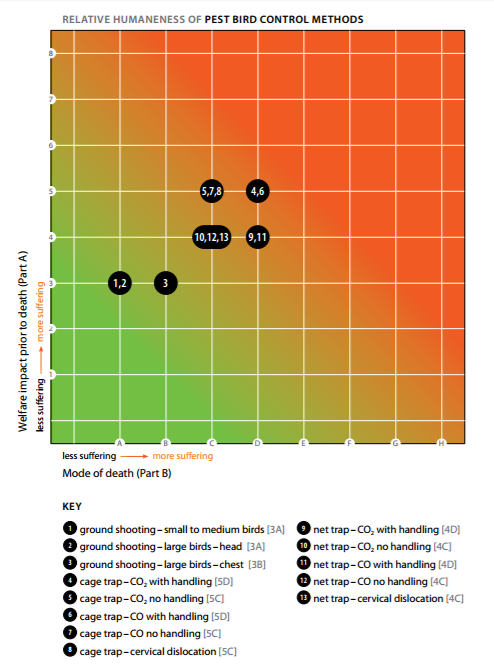
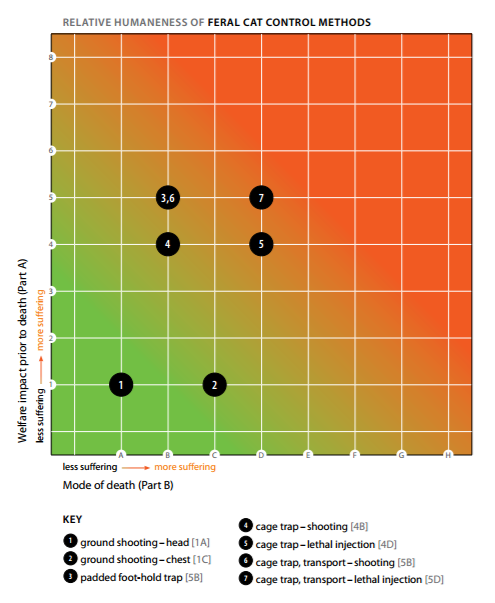
The publication includes a series of humaneness matrices, which present a simplified visual comparison of the relative humaneness of control methods for individual pest species. In these matrices, methods positioned in the green zone represent more humane options, while those in the red zone indicate increasing negative welfare impacts. As a method moves from green to red, the severity and duration of suffering experienced by the animal generally increases.
Examples from the matrices for feral cat and pest bird control—as well as those developed for other pest species—consistently show that shooting, when performed competently and in accordance with best-practice standards, ranks among the most humane control methods available.
Humaneness of Shooting
Head shooting delivers a projectile directly to the brain, causing catastrophic damage to vital tissues and bone, rapid loss of consciousness, and severe bleeding. When correctly applied, this method results in instantaneous insensibility and death and is widely regarded as the most humane outcome.
Chest shooting delivers a projectile to the heart–lung region, resulting in massive systemic blood loss and, in some cases, an immediate fatal stroke caused by hydrostatic shock. The rapid loss of blood pressure deprives the brain of oxygenated blood, leading to swift unconsciousness and death. When applied to appropriate species and under suitable conditions, chest shooting also achieves a rapid and humane outcome.